Purchasing a $600,000 home in New Jersey typically results in a total monthly housing payment between $4,428 and $5,297, depending on your down payment size, interest rate, and credit score.
Mortgage principal and interest make up only a portion of this monthly total. In New Jersey, local property taxes represent one of the largest ongoing monthly housing expenses in the nation, often adding more than $1,100 per month on a $600,000 property.
Understanding the complete monthly payment requires looking at all four components of housing cost: principal, interest, property taxes, and homeowners insurance, known together as PITI. Buyers putting down less than 20% must also budget for private mortgage insurance (PMI).
Many first time buyers in New Jersey calculate their budget using standard national mortgage rules and experience severe payment shock when their loan estimate arrives. Because New Jersey property taxes can easily equal 30% to 40% of the entire monthly mortgage payment, evaluating the local tax assessment is just as critical as shopping for the lowest mortgage rate.
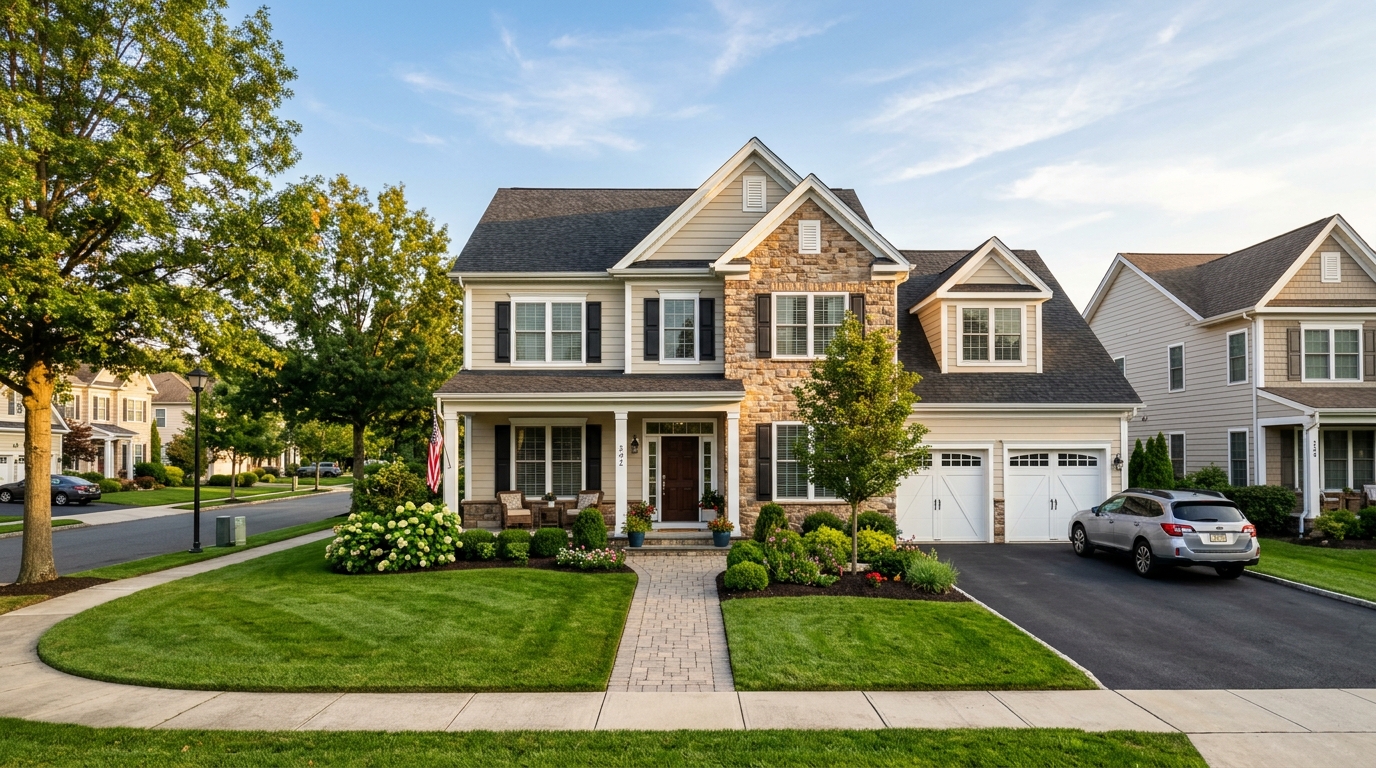
New Jersey consistently maintains the highest average effective property tax rate in the United States, averaging roughly 2.2% to 2.8% of assessed home value.
On a $600,000 house, annual property taxes generally range from $11,000 to $18,000, depending on the county, the municipality, and local school district funding formulas. That requires an escrow contribution between $915 and $1,500 every single month, billed directly inside your monthly mortgage payment.
| County | Average Effective Tax Rate | Estimated Annual Tax | Estimated Monthly Escrow |
|---|---|---|---|
| Bergen County (Paramus, Hackensack) | 2.25% | $13,500 | $1,125 |
| Essex County (Montclair, Millburn) | 2.95% | $17,700 | $1,475 |
| Morris County (Morristown, Parsippany) | 2.20% | $13,200 | $1,100 |
| Union County (Westfield, Cranford) | 2.70% | $16,200 | $1,350 |
| Middlesex County (Edison, Woodbridge) | 2.40% | $14,400 | $1,200 |
| Monmouth County (Middletown, Freehold) | 2.05% | $12,300 | $1,025 |
| Somerset County (Bridgewater, Basking Ridge) | 2.15% | $12,900 | $1,075 |
| Ocean County (Toms River, Lakewood) | 1.80% | $10,800 | $900 |
| Camden County (Cherry Hill, Voorhees) | 3.10% | $18,600 | $1,550 |
Property taxes in suburban commuter towns in Essex and Union counties are significantly higher due to municipal school budgets, county park systems, and local infrastructure maintenance. When evaluating homes in New Jersey, always check the exact public tax card from the county tax board rather than relying on listing site estimates.
New Jersey property taxes also experience annual reassessments. Many buyers suffer year two escrow shock when a municipality conducts a town wide revaluation or updates assessments after a sale, pushing monthly payments up by $100 to $250 per month to cover escrow shortages.
Your down payment percentage changes your starting loan balance, your monthly principal and interest payment, and your private mortgage insurance premium.
The table below breaks down the estimated monthly payment for a $600,000 New Jersey home purchase at a 6.75% fixed interest rate on a 30 year term, using a standard New Jersey property tax rate of 2.3% ($13,800 annually) and $165 per month for homeowners hazard insurance.
| Payment Component | 5% Down ($30,000) | 10% Down ($60,000) | 15% Down ($90,000) | 20% Down ($120,000) |
|---|---|---|---|---|
| Loan Amount | $570,000 | $540,000 | $510,000 | $480,000 |
| Principal and Interest (6.75%) | $3,697 | $3,502 | $3,308 | $3,113 |
| NJ Property Taxes (Monthly) | $1,150 | $1,150 | $1,150 | $1,150 |
| Homeowners Insurance | $165 | $165 | $165 | $165 |
| Private Mortgage Insurance (PMI) | $285 | $180 | $105 | $0 |
| Total Estimated Monthly Payment | $5,297 | $4,997 | $4,728 | $4,428 |
Putting 20% down eliminates PMI completely and lowers the loan balance, reducing your monthly payment by $869 compared to a 5% down payment. That equates to $10,428 in annual cash flow savings.
However, accumulating a $120,000 cash down payment takes years for many young families. A 10% down structure ($60,000) offers an effective middle ground, keeping monthly payments below $5,000 while preserving $60,000 in liquid reserves for home furnishings, emergency savings, and maintenance.
When you put down less than 20% on a conventional mortgage, your lender requires private mortgage insurance. On a high loan balance like $540,000 or $570,000, your credit score has a massive impact on your monthly PMI premium.
PMI pricing is calculated as an annual percentage of the starting loan balance and billed in twelve equal monthly installments. Private mortgage insurance companies evaluate credit scores in twenty point tiers.
| Credit Score Tier | 10% Down PMI Rate | Monthly PMI ($540k Loan) | 5% Down PMI Rate | Monthly PMI ($570k Loan) |
|---|---|---|---|---|
| 760 or Higher | 0.30% | $135 / month | 0.45% | $214 / month |
| 740 to 759 | 0.42% | $189 / month | 0.60% | $285 / month |
| 720 to 739 | 0.55% | $248 / month | 0.78% | $371 / month |
| 700 to 719 | 0.72% | $324 / month | 1.02% | $485 / month |
| 680 to 699 | 0.95% | $428 / month | 1.30% | $618 / month |
| 640 to 679 | 1.40% | $630 / month | 1.75% | $831 / month |
As shown in the table, moving your credit score from 690 to 760 cuts your monthly PMI premium by nearly $300 per month on a 10% down loan, saving $3,600 every year. Paying down credit card balances to boost your score prior to submitting a mortgage application is one of the highest return moves you can make.
Mortgage underwriters evaluate your qualifying income using standard debt to income (DTI) guidelines: the 28% front end ratio and the 36% back end ratio.
Under the 28% front end rule, your total housing payment (P&I, property taxes, homeowners insurance, and PMI) cannot exceed 28% of your gross monthly income before taxes.
To qualify for a $5,297 monthly payment with 5% down, your household needs a gross annual salary of at least $227,000 per year ($18,918 per month).
With 20% down and a lower $4,428 monthly payment, the required gross household income drops to roughly $190,000 per year ($15,814 per month).
The 36% back end rule factors in other monthly recurring debts. If your household carries $800 per month in car financing, student loan payments, and minimum credit card bills, that debt reduces your borrowing power. Under the 36% back end ceiling, qualifying for the 5% down payment structure requires an annual salary of approximately $235,000 to $245,000.
Mortgage lenders base loan approvals strictly on gross top-line earnings, but you pay your mortgage check with net take-home cash after taxes.
New Jersey has one of the highest progressive state income tax brackets in the country. For married couples filing jointly, state income tax rates reach 5.525% above $100,000 and 6.37% above $150,000, climbing to 8.97% above $500,000.
Consider a married couple earning $225,000 gross ($18,750 per month). After accounting for federal income taxes, New Jersey state income tax, Social Security, Medicare, employer sponsored healthcare coverage, and modest 6% contributions to their 401(k) plans, their actual net take-home pay is roughly $12,600 per month.
If this couple purchases a $600,000 home with 10% down, their monthly housing payment of $4,997 consumes 39.6% of their actual net take-home cash. While their debt to income ratio passes underwriting guidelines with ease, committing 40% of net cash flow to housing requires deliberate budgeting for childcare, commuting into Manhattan or Philadelphia, and vehicle expenses.
In addition to your down payment, you must bring sufficient cash to settlement to cover closing costs. In New Jersey, buyer closing expenses generally range from 2.5% to 3.5% of the purchase price.
On a $600,000 transaction, expect closing charges between $15,000 and $21,000. These fees include title search and examination ($2,200 to $2,900), lender origination and appraisal ($1,700 to $2,400), county deed and mortgage recording fees ($300 to $500), municipal tax and utility lien searches ($350), and legal representation ($1,500 to $2,500, as New Jersey transactions customarily involve closing attorneys).
Prepaid escrow reserves also require substantial cash. Because New Jersey property taxes are steep, lenders typically require three to four months of property taxes ($3,450 to $4,600) and a full year of homeowners insurance upfront to fund your escrow reserve account.
Your total cash to close on a $600,000 New Jersey home purchase is roughly $47,000 with 5% down, $77,000 with 10% down, and $138,000 with 20% down. Ensure you maintain additional liquid reserves in savings after closing to handle unexpected repair emergencies.
A major financial advantage for New Jersey buyers is that a $600,000 home purchase does not require a jumbo loan.
The Federal Housing Finance Agency (FHFA) sets conventional conforming loan limits annually. For standard counties nationwide, the single family baseline limit is $832,750. However, in designated high cost New Jersey counties (including Bergen, Essex, Hudson, Hunterdon, Middlesex, Monmouth, Morris, Ocean, Passaic, Somerset, and Union), the high-balance conforming loan limit reaches up to $1,249,125.
Because a $600,000 home with 5% down leaves a loan balance of $570,000, the mortgage falls well within conforming limits in every county in New Jersey. Buyers can take advantage of competitive conforming interest rates, lower down payment minimums, and standard underwriting guidelines without jumping through restrictive jumbo loan documentation hoops.
First, appeal your municipal property tax assessment. Under New Jersey Chapter 123 rules, if your home assessed value exceeds its true market value by more than 15%, you can file a tax appeal with your county board of taxation. The annual deadline to appeal in most New Jersey counties is April 1. A successful tax appeal that reduces your assessed value by $40,000 can lower your monthly escrow payment by $75 to $100 per month.
Second, explore temporary seller-paid buydowns. In a balanced housing market, ask the seller to fund a 2-1 buydown rather than discounting the purchase price. A 2-1 buydown lowers your interest rate by 2.0% in year one and 1.0% in year two, cutting your initial monthly payment by roughly $700 per month during your first year of homeownership.
Third, make targeted principal prepayments to eliminate private mortgage insurance early. Under the federal Homeowners Protection Act, you have the legal right to request PMI cancellation once your loan principal balance reaches 80% of the original purchase price. On a $540,000 loan with 10% down ($600,000 purchase), paying an extra $300 per month toward principal will hit the $480,000 threshold in roughly four years, eliminating the $180 monthly PMI fee and saving thousands in total interest.
Fourth, shop around for homeowners insurance quotes. In coastal New Jersey counties (Monmouth, Ocean, Atlantic, Cape May), flood zones and windstorm deductibles can double insurance premiums. Shopping three independent insurance brokers before closing can save $500 to $1,000 annually.
Every municipality in New Jersey sets its own tax rate, which directly impacts your monthly payment.
Use our New Jersey calculators to test your specific numbers:
- New Jersey Mortgage Calculator with state tax presets and local county assessment rates.
- New Jersey Closing Cost Calculator with state realty transfer tax rules and recording fees.
- Home Affordability Calculator to calculate your maximum home price based on your exact salary and debt.
- PMI Calculator to estimate private mortgage insurance premiums by credit score tier.
Reviewing both the purchase price and the local property tax rate ensures you have an accurate picture of the true monthly cost before submitting an offer in New Jersey.